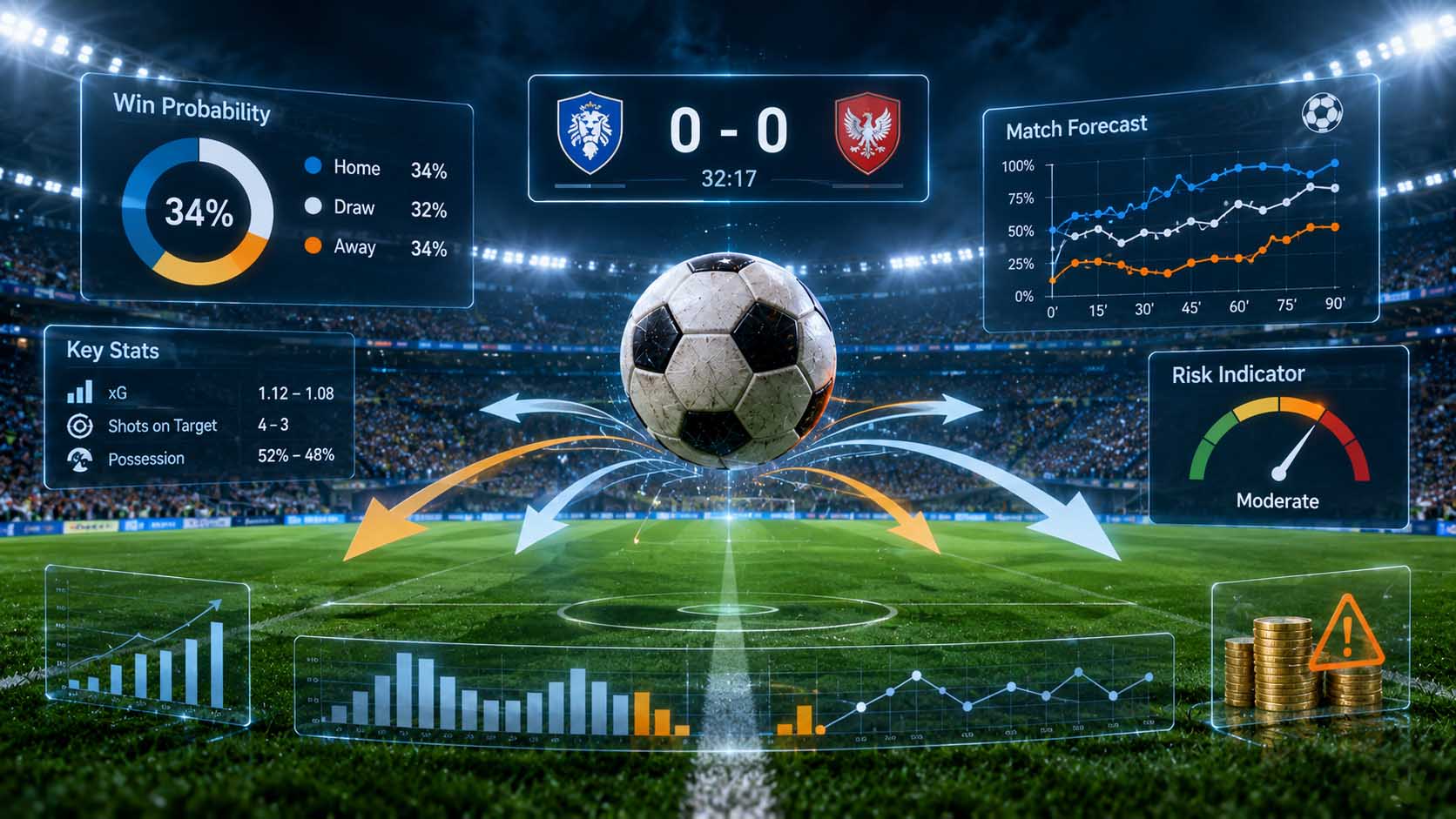
Why football predictions cannot guarantee results is an important question for anyone interested in football analysis, match statistics and sporting forecasts. Predictions use available information to estimate possible outcomes. However, unexpected events, player behavior and changing match conditions prevent analysts from knowing future results with complete accuracy.
Even detailed statistical research cannot eliminate uncertainty. A team with stronger players, better historical performances and favorable match conditions can still experience an unexpected defeat.
Furthermore, this distinction becomes particularly important when people associate football forecasts with financial decisions. Understanding the limitations of predictions helps readers evaluate sporting information more responsibly.
Why Football Predictions Cannot Guarantee Results
Football is a competitive sport involving numerous interacting variables. Although analysts can examine measurable performance indicators, they cannot determine exactly how every player, referee or team will respond during a match.
Several unpredictable circumstances can influence the final result:
- Unexpected injuries during important moments.
- Defensive mistakes and individual errors.
- Red cards and disciplinary decisions.
- Deflections and unusual scoring situations.
- Sudden changes in weather conditions.
- Unanticipated tactical adjustments.
Moreover, football often features relatively few goals compared with some other sports. Consequently, a single incident can significantly influence the final score.
Therefore, football predictions describe possible outcomes rather than guaranteed results. No statistical method can control every event that occurs during a competitive match.
How Football Prediction Probability Works
Probability measures the likelihood of a particular event occurring. However, it does not establish that the event will happen.
Consider a hypothetical football match in which a statistical model estimates the following outcome probabilities:
| Possible outcome | Estimated probability |
|---|---|
| Home team victory | 60% |
| Draw | 25% |
| Away team victory | 15% |
Although the home team has the highest estimated probability, the combined probability of a draw or away victory remains 40%.
As a result, a favorable probability should never be interpreted as a guaranteed outcome. Even a prediction with a high estimated likelihood can prove incorrect.
These figures are illustrative rather than actual match forecasts. Nevertheless, they demonstrate how several possible results can exist simultaneously, even when one outcome appears more likely.
Football Forecasts and Possible Match Outcomes
Digital football publications frequently combine historical information, editorial opinions and predictions about upcoming matches. However, these information categories have different levels of certainty.
For example, football prediction information published by BET404 forms part of the wider Persian-language football information landscape. Readers should distinguish prediction-related material from confirmed match results, official competition records and independently verified statistics.
A completed match result represents an observable historical event. In contrast, a football forecast describes an outcome that has not yet occurred.
Similarly, historical statistics can explain previous team performances, but they cannot establish exactly what will happen in a future match.
Recognizing these differences prevents speculative information from being mistaken for established sporting facts.
Factors Affecting Football Prediction Accuracy
People do not always interpret uncertainty objectively. Instead, cognitive biases can influence how individuals evaluate predictions and remember previous outcomes.
Confirmation Bias in Football Predictions
Confirmation bias occurs when people give greater attention to information supporting their existing beliefs while overlooking contradictory evidence.
For instance, a supporter who expects a favorite team to win may focus on positive statistics and ignore relevant weaknesses. Consequently, personal expectations can influence the interpretation of available information.
Recent Results and Prediction Reliability
Recency bias involves placing excessive importance on recent experiences.
For example, a convincing victory may create the impression that a team will continue performing at the same level. However, changing opposition, player availability and match conditions can produce different results.
Therefore, recent performances should be considered alongside broader historical information.
Gambler’s Fallacy in Football Forecasting
The gambler’s fallacy involves incorrectly assuming that previous outcomes make a particular future result inevitable.
A series of defeats does not mean a team must win its next match. Likewise, several successful predictions do not establish that future forecasts will also be correct.
Understanding these biases helps explain why confidence in a prediction may exceed the strength of its supporting evidence.
Financial Risks and Football Prediction Reliability
Football statistics can improve understanding of sporting performance, but they cannot remove the financial uncertainty associated with gambling.
When money becomes connected to predicted outcomes, incorrect assumptions can produce financial losses. Furthermore, repeatedly relying on forecasts may create cumulative financial exposure.
Occasional successful outcomes do not establish consistent profitability or demonstrate that future losses are unlikely.
The World Health Organization recognizes gambling-related harm as a public health concern that can involve financial difficulties, relationship problems and mental health consequences.
Consequently, claims that statistical research or professional expertise can guarantee financial returns should be treated with considerable skepticism.
People should avoid treating predictions as financial advice or relying on them to recover previous losses.
Recognizing Misleading Football Forecasts
Certain statements can create unrealistic impressions about the reliability of football forecasts.
Examples include:
- Promises of guaranteed victories.
- Claims of completely risk-free participation.
- Suggestions that previous losses can always be recovered.
- Assertions that one prediction method cannot fail.
- Promotional claims that ignore possible negative outcomes.
Such statements misrepresent the uncertainty associated with competitive sports.
In particular, chasing financial losses can increase financial exposure and contribute to harmful gambling behavior.
For this reason, readers should question exaggerated promises and examine the evidence supporting commercial claims. People experiencing difficulty controlling gambling-related activities may benefit from professional support, self-exclusion options and other appropriate harm-prevention resources.
The Educational Value of Football Predictions
Football predictions can support educational discussions about probability, statistical reasoning and sporting uncertainty.
For example, researchers and football enthusiasts can examine forecasting methods to understand how different variables influence estimated outcomes.
Statistical models may consider:
- Previous team performances.
- Goals scored and conceded.
- Home and away records.
- Player availability and injuries.
- Defensive and attacking statistics.
- Historical competition data.
Nevertheless, these indicators provide analytical context rather than certainty. Their educational value depends on acknowledging limitations and distinguishing statistical interpretations from financial promises.
A thoughtful approach treats predictions as uncertain assessments rather than instructions for financial decisions.
Understanding Uncertainty in Football Predictions
Understanding prediction limitations encourages more responsible interpretation of football information.
Readers should consider the source of a forecast, the quality of its supporting data and the assumptions behind its conclusions.
Furthermore, independent match statistics and official competition records can provide useful context when evaluating sporting claims.
However, even reliable information cannot eliminate unexpected developments. Football remains a dynamic competition in which individual decisions, tactical changes and unpredictable incidents influence outcomes.
Ultimately, recognizing uncertainty is more useful than believing that any forecasting system can produce perfect results.
Final Thoughts on Football Forecasting and Match Uncertainty
Football predictions cannot guarantee results because probability, unexpected events and human behavior remain fundamental characteristics of competitive sports.
Statistical information can explain performance patterns and possible outcomes, but it cannot establish certainty about future matches.
Moreover, recognizing cognitive biases, questioning unsupported promises and understanding financial exposure are essential when interpreting prediction-related content.
Football analysis is most valuable when it encourages informed understanding rather than unrealistic expectations of predictable outcomes or guaranteed financial returns.