In the architecture of digital wagering software, game developers utilize various mathematical modifiers to create dynamic payout structures and enhance user engagement. Among these mechanics, escalating reward systems have become a cornerstone of modern game design. Understanding progressive multipliers provides valuable insight into how computational logic tracks consecutive events, calculates compounding values, and influences the overall mathematical variance of a digital application.
By analyzing how these multipliers interact with random number generators (RNG) and game matrices, software enthusiasts can better comprehend the structural complexity behind interactive features. This guide examines the computational triggers, state-tracking mechanisms, and mathematical implications of progressive multiplier systems.
What Is a Progressive Multiplier?
In digital software design, a multiplier is a predefined mathematical variable that increases the standard payout of a qualifying event. A progressive multiplier introduces a dynamic state where this variable is not static; instead, it incrementally increases based on specific in-game conditions being met consecutively or within a bounded feature phase.
Unlike fixed multipliers—which apply a constant value (e.g., 2x or 5x) to a specific symbol or payline—progressive systems start at a base value (often 1x) and escalate according to the rules defined in the game’s internal paytable and computational logic.
Computational Logic and Trigger Mechanisms
Implementing a progressive multiplier requires the software to track the “state” of a single game round continuously. This state management is typically tied to specific interactive mechanics that allow a single spin cycle to encompass multiple evaluation phases.
Cascading Matrices and Consecutive Evaluations
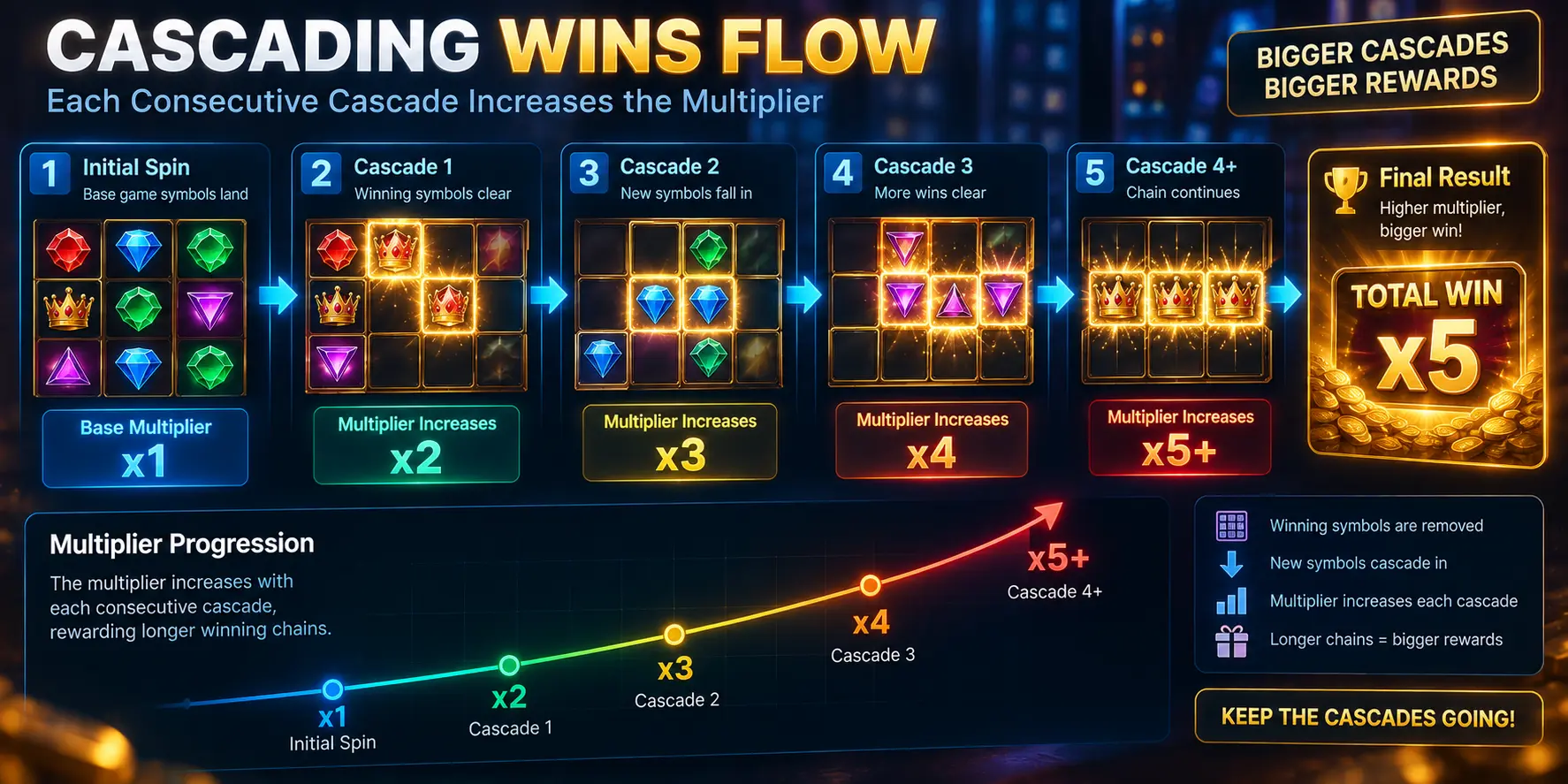
The most common implementation of progressive multiplier logic occurs alongside cascading (or avalanche) mechanics. When a qualifying symbol combination lands, the software calculates the initial outcome, removes the participating symbols, and allows new symbols to drop into the matrix.
If this newly formed grid results in another qualifying event, the progressive multiplier increases by a predefined step (e.g., from 1x to 2x). This loop continues until no further combinations are generated, at which point the software resets the multiplier state to its baseline value for the next independent round.
Feature-Bound Multiplier States
In addition to base-game cascading mechanics, progressive multipliers are frequently isolated within specific bonus features, such as free spin rounds. In these bounded environments, the software may be programmed to prevent the multiplier from resetting between individual spins, allowing the value to compound across the entire duration of the feature.
When analyzing how complex digital platforms structure interactive game features and present reference information, reviewing varied technical implementations—such as accessing an info slot maxwin terbaru catalog configuration—illustrates how different web systems organize digital resources. However, it is important to note that underlying math models, multiplier limits, and feature triggers vary widely across individual titles, and referencing a platform does not independently verify a specific mathematical configuration.
Mathematical Impact on Volatility and Payouts
The integration of progressive multipliers heavily influences a game’s theoretical volatility (variance). Because the potential for escalating multipliers introduces the possibility of disproportionately large payouts during prolonged cascading sequences or feature rounds, the software must balance these events mathematically.
To maintain the target Return-to-Player (RTP) percentage, developers often allocate a significant portion of the game’s mathematical weight to the upper tiers of the multiplier scale. Consequently, games utilizing aggressive progressive multipliers typically exhibit high volatility, meaning standard base-game evaluations may be smaller or less frequent to offset the mathematical liability of the compounding multiplier feature.
Common Questions About Multiplier Mechanics
Do progressive multipliers change the base RNG probabilities?
No. The Random Number Generator (RNG) continues to determine symbol distribution independently for each cascade or spin. The multiplier is an evaluation modifier applied after the RNG determines the grid outcome; it does not alter the mathematical probability of specific symbols landing.
Are progressive multiplier limits hardcoded into the software?
Yes. To manage mathematical liability, software developers program hardcoded caps or maximum payout limits into the game engine. Even if a progressive sequence continues theoretically, the software will truncate the multiplier or cap the total feature payout once the predetermined maximum threshold is reached.
How is the multiplier state tracked during a session?
The game server maintains temporary state data for the active round. In the event of a visual disconnection or browser crash, the server’s backend logic has already calculated the final outcome and multiplier state the moment the initial trigger occurred, ensuring accurate ledger reconciliation.
Conclusion
Understanding progressive multipliers reveals the sophisticated state-tracking and mathematical balancing required in modern digital game development. By integrating dynamic variables with cascading mechanics and bounded feature environments, software architects create highly volatile, mathematically complex architectures that continue to drive innovation in interactive digital environments.