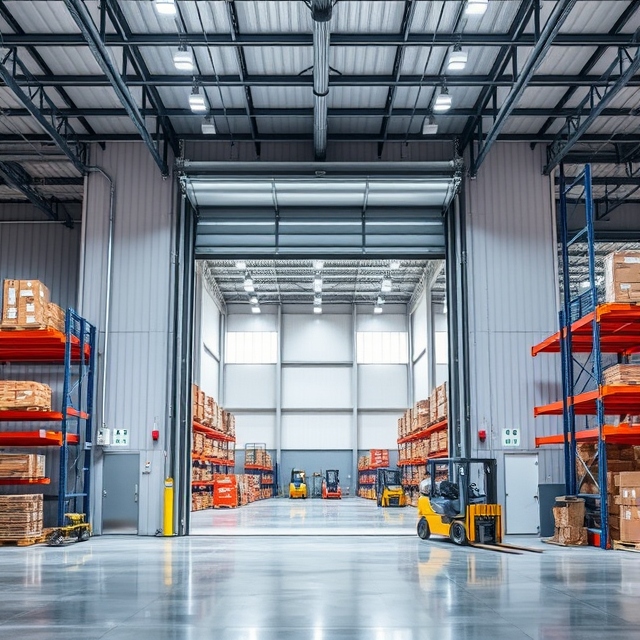
Effective cold storage temperature control depends on more than refrigeration equipment. Warehouse doorways are also important because every opening creates a temporary connection between spaces with different temperatures. When doors remain open for extended periods or do not seal effectively, warmer air can enter and colder air can escape.
This matters in refrigerated warehouses, freezer rooms, food-processing facilities, and other temperature-controlled environments where products must remain within defined conditions. A well-planned doorway can support the overall temperature-control strategy while still allowing people, forklifts, and products to move efficiently.
Why Warehouse Doorways Matter in Cold Storage
A cold-storage facility usually separates areas with different environmental conditions. A refrigerated room may connect to an ambient warehouse, loading dock, production area, or another temperature-controlled zone.
When the doorway is closed, the door assembly acts as part of the physical barrier between those spaces. When it opens, however, air can move between them.
The amount of exchange depends on several factors, including:
- Temperature difference between the two areas
- Door opening duration
- Frequency of traffic
- Opening dimensions
- Door construction
- Sealing around the opening
- Air movement within the facility
- Location of the doorway
Therefore, temperature control should consider the doorway as part of the facility’s complete environmental system rather than treating it as a separate architectural component.
What Is Air Infiltration?
Air infiltration is the unwanted movement of air through or around an opening, gap, or building component.
At a cold-storage doorway, infiltration can occur when warmer surrounding air enters the refrigerated space while colder air moves outward. The effect can become more noticeable when there is a substantial temperature difference between the two areas.
Door design cannot eliminate every instance of air exchange when an opening is actively being used. However, appropriate construction, sealing, and operating practices can help reduce unnecessary exposure.
How Door Opening Time Influences Temperature Conditions
One of the simplest factors to understand is opening duration.
If a cold-room door remains open while a forklift completes a transfer, the doorway stays exposed to the surrounding environment for that period. If the same opening is used repeatedly throughout the day, the cumulative exposure can become an important operational consideration.
This does not mean that every cold-storage facility needs the fastest possible door. Instead, the operating speed should correspond to the traffic pattern.
A low-traffic storage room may have very different requirements from a distribution center where pallets cross the doorway continuously.
The Role of Door Sealing
A closed door should provide a practical separation between the temperature-controlled space and its surroundings.
Seals around the door perimeter can help limit unwanted air movement when the door is closed. The condition of those seals matters as well. Damaged, compressed, misaligned, or deteriorated sealing components can create gaps that reduce the effectiveness of the barrier.
The complete installation should therefore be considered, including:
- Door panel or curtain
- Frame
- Perimeter seals
- Bottom seal
- Tracks or guides
- Joints and connections
- Surrounding wall construction
Good temperature management depends on the complete doorway rather than one individual component.
Why Insulation Matters
Insulation helps reduce heat transfer through the door structure. This is particularly relevant when the doorway separates a cold room from a significantly warmer area.
The appropriate construction depends on the application. A freezer opening may have different requirements from a chilled-storage entrance, while a frequently used logistics doorway may require a different configuration from a small access door.
For facilities evaluating insulated cold storage doors, insulation should be considered alongside sealing, operating frequency, opening dimensions, and the temperature difference across the doorway.
Traffic Creates a Practical Temperature-Control Challenge
Cold-storage facilities cannot simply keep their doors closed all day. Products need to move, workers need access, and forklifts or other material-handling equipment may need to cross between zones.
This creates a balance between access and environmental separation.
A doorway used for frequent forklift traffic may benefit from an operating configuration designed around repeated cycles. Automatic activation can also allow a door to respond to approaching vehicles or equipment rather than requiring an operator to stop and manually open it.
For automated warehouses, doors may also interact with conveyors, AGVs, AMRs, or other material-handling systems. In these environments, the doorway becomes part of the wider logistics process.
Door Type Should Match the Application
Different cold-storage door configurations address different operating requirements.
Sliding Doors
Cold-storage sliding doors can be useful for larger insulated openings where horizontal movement is practical. They can provide a substantial barrier and may be suitable for areas where frequent access is required but the facility has adequate space for the sliding arrangement.
High-Speed Doors
High-speed cold-storage doors are designed around rapid opening and closing. They can be considered for busy openings where minimizing the time an entrance remains exposed is important.
The correct configuration still depends on the temperature range, traffic frequency, opening dimensions, and required sealing performance.
Self-Repairing Doors
In areas where equipment may accidentally contact a door, self-repairing designs can be considered. Their ability to return the curtain to its guides after certain impacts can be useful in high-traffic environments, although the suitability of a particular system depends on its design and application.
Where Doorways Have the Greatest Operational Impact
Not every opening in a cold-storage facility has the same requirements.
Cold Room to Ambient Warehouse
This transition can involve a significant temperature difference. Door insulation, sealing, and access frequency should therefore be considered together.
Freezer to Refrigerated Area
Different temperature-controlled zones may still require careful separation. Frequent movement between them can influence the choice of door and its operating method.
Cold Storage to Loading Dock
Loading areas often experience vehicle and pallet traffic. The door needs to support logistics while helping maintain separation between the cold environment and the loading area.
Production to Cold Storage
Food-processing facilities may require regular movement of workers and products. Door selection may therefore involve both environmental control and workflow requirements.
A Practical Approach to Improving Temperature Control
Facility managers can start by examining how each doorway is actually used.
First, record the temperature on both sides of the opening and identify the temperature difference.
Next, examine traffic frequency. Determine whether the door is used occasionally or continuously and identify whether the traffic consists of people, forklifts, pallets, carts, or automated equipment.
Then review the physical opening. Check its width, height, surrounding space, and whether equipment or storage areas restrict door movement.
Finally, inspect the door itself. Look for damaged seals, gaps, alignment issues, unusual movement, or other conditions that could affect operation and environmental separation.
This approach helps identify whether the main issue involves door selection, operating practices, maintenance, traffic management, or a combination of factors.
Common Questions About Cold Storage Doorways
Can a warehouse door affect cold-room temperature?
Yes. Opening a doorway allows air exchange between the cold room and the surrounding area. The effect depends on factors such as opening duration, traffic frequency, temperature difference, and the door’s construction and sealing.
Does a faster door automatically provide better temperature control?
Not necessarily. Faster operation can reduce the time an opening remains exposed, but temperature performance also depends on insulation, sealing, installation, traffic patterns, and the suitability of the complete door system.
Why are door seals important in refrigerated warehouses?
Door seals help limit air movement around the closed doorway. Maintaining the seals and ensuring that the door closes correctly can therefore support the separation between different temperature zones.
Should every cold-storage doorway use the same door?
No. Different openings can have different temperatures, traffic patterns, dimensions, and space constraints. A small personnel entrance may require a different configuration from a high-traffic forklift opening.
Designing the Doorway as Part of the Cold-Storage System
A cold-storage doorway has two jobs that can sometimes compete with each other: it must provide practical access while helping separate different environmental conditions.
The most appropriate solution depends on the specific opening. Temperature, traffic, insulation, sealing, operating speed, available space, and material-handling requirements should all be considered before selecting a door.
When these factors are evaluated together, warehouse doorways can become an integrated part of the facility’s temperature-control and logistics strategy rather than simply being treated as points of entry and exit.