Oxygen purity in a home oxygen concentrator refers to the percentage of oxygen present in the gas that the machine produces. Unlike an oxygen cylinder that stores compressed oxygen, a concentrator processes surrounding air to produce oxygen-enriched gas for prescribed oxygen therapy.
Many medical-grade stationary oxygen concentrators deliver oxygen concentrations around 90% to 95% under their rated operating conditions. However, exact performance varies by manufacturer, model, and operating settings.
Understanding oxygen concentration matters because purity and flow rate describe different aspects of equipment performance. A concentrator must provide oxygen-enriched gas at an appropriate concentration while supporting the flow rate prescribed by a healthcare professional.
What Is Oxygen Purity in an Oxygen Concentrator?
Oxygen purity describes how much of the gas leaving a concentrator consists of oxygen.
Normal atmospheric air contains approximately 21% oxygen, with nitrogen making up most of the remaining gas.
An oxygen concentrator separates much of this nitrogen from surrounding air, increasing the oxygen concentration in its output.
For example, if a concentrator produces gas containing 93% oxygen, approximately 93% of that gas consists of oxygen molecules.
The remaining portion primarily contains argon and residual nitrogen.
However, a high oxygen concentration does not automatically make the equipment suitable for every patient. The prescribed flow rate, oxygen delivery method, and individual medical requirements also matter.
How Does a Home Oxygen Concentrator Produce Oxygen?
Most stationary home oxygen concentrators use a process called pressure swing adsorption (PSA).
This technology separates nitrogen from air using specialized materials known as molecular sieves.
Understanding the Oxygen Separation Process
The process generally involves several stages.
First, the concentrator draws surrounding air through its intake system.
Next, an internal compressor pressurizes the air and directs it into adsorption beds containing molecular sieve material.
Under pressure, the material preferentially captures nitrogen, allowing oxygen-enriched gas to pass through.
The system then changes pressure to release the captured nitrogen and regenerate the adsorption material.
By repeating these cycles, the concentrator produces a continuing supply of oxygen-enriched gas.
This process allows stationary concentrators to operate without requiring regular replacement of compressed oxygen cylinders.
Nevertheless, the equipment still depends on electricity, adequate ventilation, and proper maintenance.
Oxygen Purity vs. Oxygen Flow Rate: What Is the Difference?
Oxygen purity and oxygen flow rate are separate measurements.
Purity describes the percentage of oxygen in the gas that a concentrator produces.
Meanwhile, flow rate describes how much gas the device delivers over a specific period.
Healthcare professionals commonly measure oxygen flow in liters per minute (LPM).
| Feature | Oxygen Purity | Oxygen Flow Rate |
|---|---|---|
| Definition | Percentage of oxygen in the output gas | Volume of gas delivered per minute |
| Measurement | Percentage (%) | Liters per minute (LPM) |
| Main purpose | Indicates oxygen concentration | Indicates gas delivery volume |
| Equipment specification | Manufacturer-defined concentration range | Manufacturer-defined flow range |
| Clinical importance | Helps describe equipment performance | Must support prescribed oxygen delivery |
Example of Oxygen Concentration and Flow Rate
Consider a concentrator operating at a flow rate of two liters per minute with an oxygen concentration of 93%.
The device delivers approximately two liters of oxygen-enriched gas each minute.
At a concentration of 93%, that output contains approximately 1.86 liters of oxygen per minute.
However, this calculation describes the oxygen content of the equipment’s output gas.
It does not indicate how much oxygen reaches the patient’s lungs or bloodstream.
Actual oxygen delivery depends on breathing patterns, tubing arrangements, delivery interfaces, and clinical conditions.
Therefore, patients should never adjust prescribed oxygen flow based solely on concentration calculations.
Understanding Oxygen Purity Specifications in Real Equipment
Manufacturers publish oxygen concentration specifications to describe how their devices should perform under defined operating conditions.
These specifications often include a nominal concentration and an acceptable tolerance.
For example, the DeVilbiss 525KS specifications describe a stationary oxygen concentrator with a nominal oxygen concentration of 93% ± 3% across its specified 1–5 LPM operating range.
This specification represents an approximate concentration range of 90% to 96% under the applicable operating conditions.
The DeVilbiss 525KS provides an example of a stationary home oxygen concentrator that supports continuous-flow oxygen delivery.
However, different models may have different concentration tolerances and operating limitations.
Consequently, buyers should review the manufacturer’s documentation for the exact model rather than assuming every five-liter concentrator produces identical oxygen concentrations.
Does Increasing Oxygen Flow Affect Oxygen Purity?
Increasing oxygen flow does not necessarily reduce oxygen concentration when a concentrator operates within its manufacturer-specified range.
However, equipment performance can change when operating conditions exceed the device’s designed capabilities.
Every concentrator has technical limits that depend on its compressor, adsorption system, and internal components.
For example, users should not expect a machine with a maximum rated flow of five liters per minute to maintain its specified performance beyond that limit.
In addition, concentration performance may vary across supported flow settings.
The manufacturer’s published specifications provide the appropriate reference.
Patients should never increase oxygen flow beyond prescribed settings to compensate for suspected equipment problems.
How Is Oxygen Purity Measured?
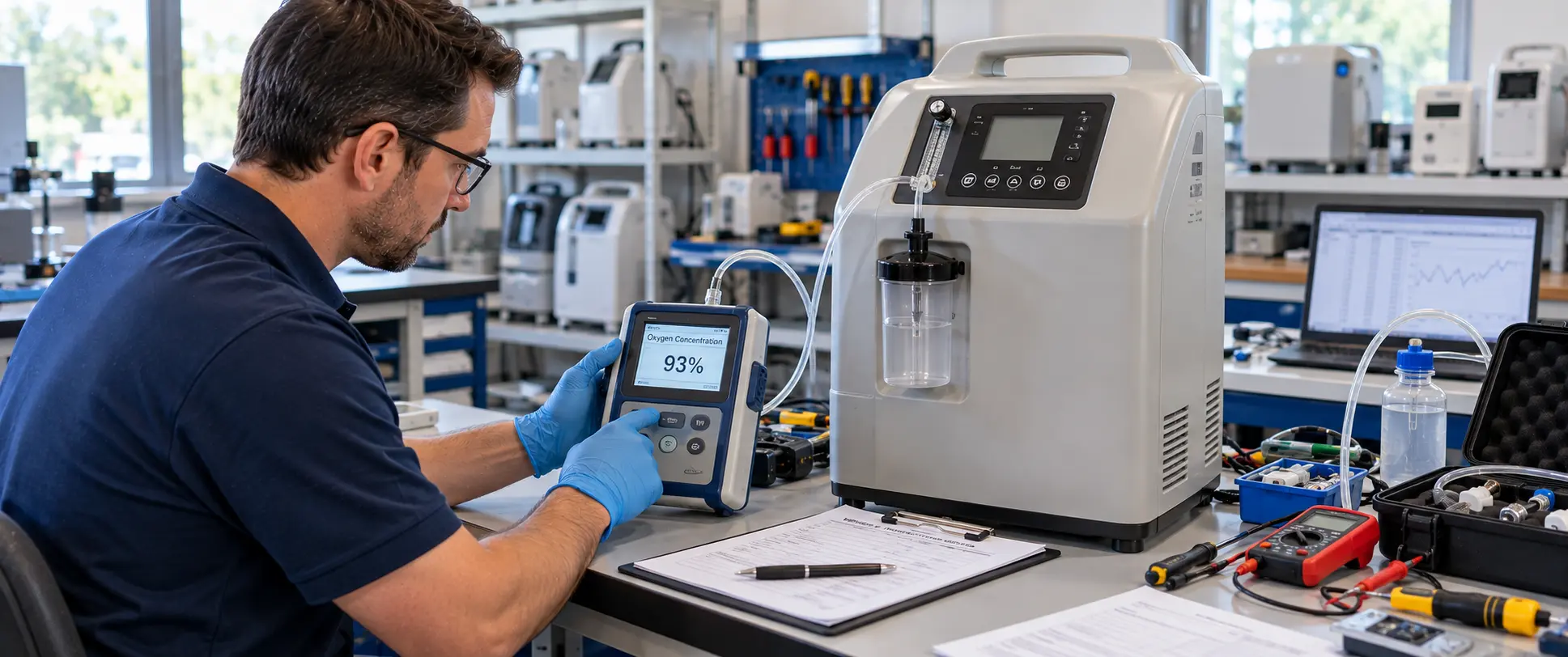
Technicians can measure oxygen concentration using a suitable oxygen analyzer.
An oxygen analyzer evaluates the oxygen percentage in a gas sample and displays the measured concentration.
Medical equipment technicians may use calibrated analyzers when inspecting or servicing concentrators.
What Is an Oxygen Percentage Indicator?
Some oxygen concentrators include an Oxygen Percentage Indicator (OPI) or a similar monitoring system.
This feature monitors oxygen concentration and can provide alerts when the measured concentration falls below specified thresholds.
However, oxygen concentration monitoring differs from measuring a patient’s blood oxygen saturation.
An OPI evaluates the concentrator’s output gas.
In contrast, a pulse oximeter estimates the percentage of hemoglobin carrying oxygen in a person’s blood.
These measurements serve different purposes and should not be confused.
In addition, monitoring features do not replace routine equipment maintenance or professional servicing.
What Factors Can Affect Oxygen Concentrator Purity?
Several operating conditions can influence oxygen concentration and overall concentrator performance.
Blocked Airflow and Poor Ventilation
Concentrators require an adequate supply of surrounding air.
Blocked intake openings or insufficient ventilation can interfere with normal operation.
Therefore, users should follow the manufacturer’s instructions for equipment positioning and airflow clearance.
Avoid placing a concentrator inside an enclosed cabinet or directly against surfaces that obstruct ventilation.
Dirty or Improperly Maintained Filters
Filters help protect the concentrator’s internal components from dust and airborne particles.
Excessively dirty filters or incorrect maintenance practices may interfere with equipment performance.
Therefore, users should follow the manufacturer’s recommended cleaning and replacement procedures.
Some filters require routine cleaning, while others need replacement according to the equipment’s maintenance schedule.
Internal Component Wear
Compressors, valves, and adsorption materials may experience wear during long-term operation.
As a result, older equipment may require inspection or servicing to maintain reliable performance.
Qualified technicians should handle internal repairs rather than untrained users.
Regular servicing can also help identify developing equipment problems.
Environmental Conditions
Temperature, altitude, and humidity can influence concentrator operation.
Manufacturers establish acceptable environmental conditions for their equipment.
Therefore, users should consult the relevant manual when operating a concentrator in unusual environments.
For example, operation outside the manufacturer’s specified altitude or temperature range may affect performance.
Is Higher Oxygen Purity Always Better?
Higher oxygen purity does not automatically make one concentrator better than another.
A device must meet the patient’s prescribed oxygen delivery requirements while operating within its specified performance limits.
For example, a concentrator advertising a slightly higher nominal oxygen concentration may still be unsuitable if it cannot provide the necessary flow rate.
Similarly, a machine with appropriate oxygen concentration may not meet a patient’s needs if it uses an incompatible delivery method.
Equipment suitability depends on the complete oxygen delivery arrangement, not one advertised percentage.
A healthcare professional should determine which device characteristics are appropriate for an individual patient.
Oxygen Purity and Safe Home Oxygen Therapy
Understanding oxygen concentration is only one part of using home oxygen equipment safely.
Patients must also follow their prescribed oxygen settings and the manufacturer’s operating instructions.
The U.S. Food and Drug Administration’s guidance on home oxygen therapy explains why patients should use oxygen concentrators under medical direction and observe appropriate safety precautions.
Because oxygen supports combustion, users must keep equipment away from smoking, open flames, and other ignition sources.
Additionally, stationary concentrators depend on electricity. Patients who require uninterrupted oxygen delivery should discuss suitable backup arrangements with their healthcare professional and equipment provider.
A backup plan should match the patient’s clinical requirements and account for possible equipment failures or power interruptions.
Common Questions About Oxygen Purity
Is 93% Oxygen Purity Normal for a Home Concentrator?
Yes. A nominal oxygen concentration around 93% is common among medical-grade stationary oxygen concentrators.
However, acceptable performance depends on the manufacturer’s specifications for the exact model.
Technicians should evaluate concentration readings against the applicable operating range and tolerance.
Does Oxygen Purity Mean Blood Oxygen Saturation?
No. Oxygen purity describes the concentration of oxygen in the gas that a concentrator produces.
Blood oxygen saturation describes the proportion of hemoglobin carrying oxygen in the bloodstream.
Although both measurements involve oxygen, they assess different characteristics.
Therefore, a concentrator producing 93% oxygen does not mean a patient’s blood oxygen saturation will reach 93%.
Can Users Adjust Oxygen Purity?
Most stationary home oxygen concentrators do not provide a normal user control for independently adjusting oxygen concentration.
Instead, the equipment maintains concentration according to its internal operating design.
Users may have access to a flow adjustment control. However, they should only change oxygen flow according to professional medical instructions.
What Should Users Do if Oxygen Purity Drops?
If a concentrator displays a low-oxygen warning, users should follow the manufacturer’s instructions and their clinician-approved backup oxygen plan.
They should not attempt internal repairs or increase oxygen flow without medical guidance.
If oxygen delivery stops and the patient develops severe breathlessness or other emergency symptoms, seek emergency medical assistance.
Why Understanding Oxygen Purity Matters
Oxygen purity is an important specification because it describes the concentration of oxygen that a home oxygen concentrator produces.
However, buyers and patients should consider this measurement alongside flow rate, equipment operating limits, and prescribed oxygen requirements.
Understanding these differences helps people interpret manufacturer specifications accurately and avoid misleading equipment comparisons.
Reliable oxygen therapy depends on appropriate medical guidance, suitable equipment, correct operation, and maintenance according to the manufacturer’s instructions.