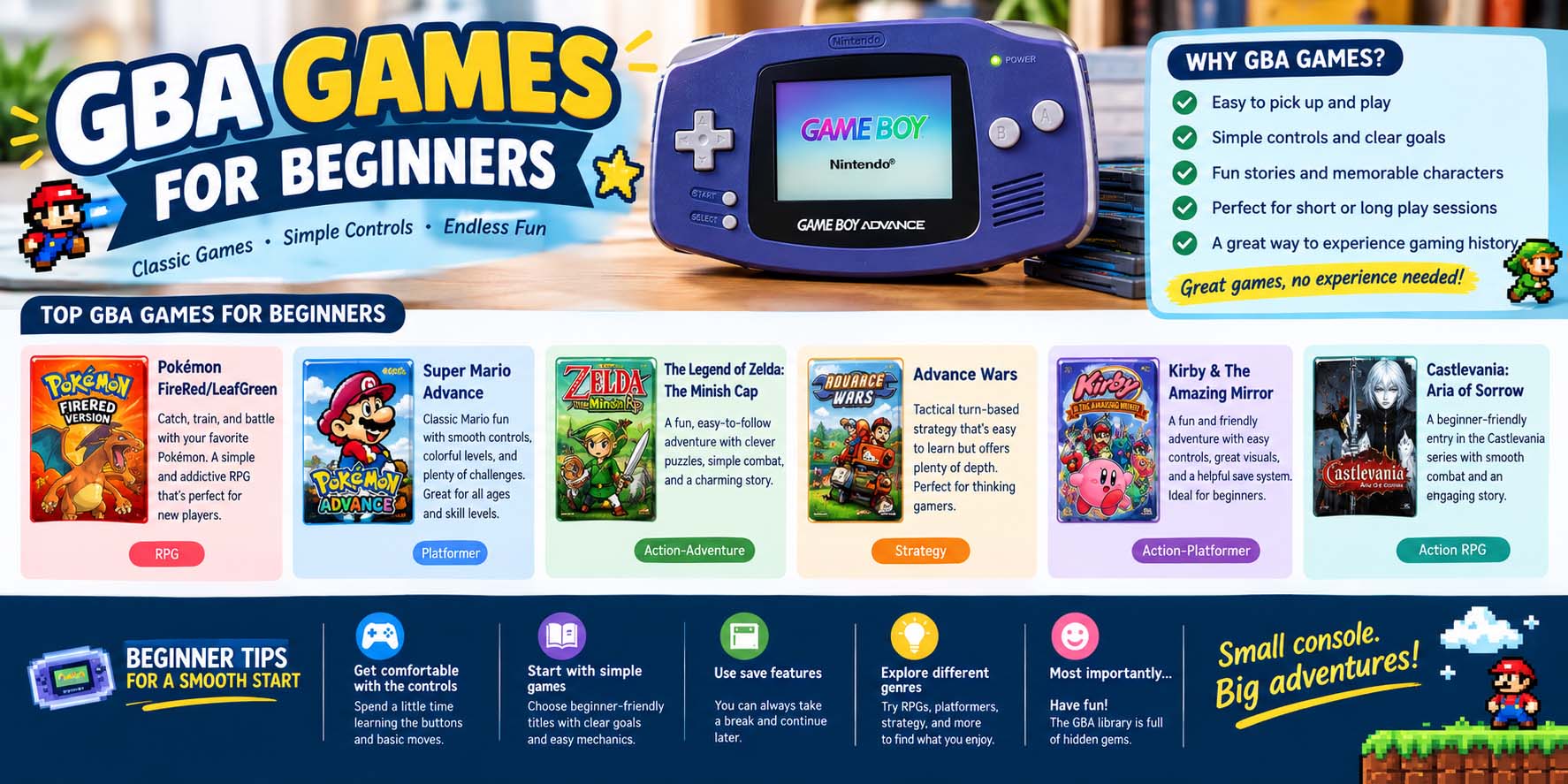
The best GBA games for beginners are titles with understandable controls, clear goals, manageable learning curves, and gameplay that becomes enjoyable quickly. Pokémon, Kirby, Mario, and Zelda games are strong starting points because they introduce their mechanics gradually while still providing enough variety and progression to keep new players interested.
However, the right first Game Boy Advance game also depends on what the player already enjoys. Someone who likes RPGs may want a completely different starting experience from someone interested in platforming, racing, or action-adventure games.
What Makes a GBA Game Beginner-Friendly?
A beginner-friendly game should make its basic mechanics easy to understand without removing all challenge.
Clear controls are especially important. New players should be able to understand how to move, interact, attack, navigate menus, or perform other essential actions without repeatedly consulting outside instructions.
Progression should also feel logical. A well-designed introductory experience teaches players through gameplay and gradually introduces new mechanics.
Difficulty matters too. Beginners do not necessarily need the easiest possible game, but early challenges should give them enough time to understand how the game works.
These qualities are particularly useful for players who are new not only to the Game Boy Advance but to retro handheld gaming in general.
Why Pokémon Works Well for First-Time GBA Players
Pokémon is one of the most approachable starting points for players interested in RPGs.
The basic gameplay loop is easy to understand: explore the world, catch Pokémon, build a team, battle trainers, and continue toward new locations and challenges.
Although Pokémon games contain deeper systems, beginners do not need to master everything immediately.
A new player can learn about different moves, Pokémon types, team composition, items, and battle strategies gradually. This creates an accessible starting point while leaving considerable room for experimentation.
Pokémon Emerald is particularly recognizable within the GBA library, but the broader reason Pokémon works for beginners is its combination of clear progression and optional depth.
Kirby Offers Accessible Action and Platforming
Players who prefer direct action instead of turn-based battles may find Kirby a comfortable introduction.
Kirby games generally make movement and basic abilities understandable without requiring advanced mechanical skill immediately. Players can concentrate on navigating environments, defeating enemies, experimenting with abilities, and discovering routes through levels.
Kirby & The Amazing Mirror adds exploration to that foundation, creating an experience that can introduce newcomers to both platforming and a less linear style of progression.
The colorful presentation also makes important objects, characters, and environments relatively easy to distinguish.
Accessibility does not mean the experience lacks depth. Instead, the basic gameplay gives beginners room to learn before demanding more from them.
Mario Is Familiar but Still Rewards Skill
Mario games can also provide a useful introduction to the Game Boy Advance.
Platforming fundamentals such as running, jumping, avoiding hazards, and learning level layouts are straightforward concepts. However, successful platformers can gradually ask players to improve their timing and movement.
This creates a natural learning curve.
Early sections establish the basic rules, while later challenges test how well the player has understood them.
Mario’s familiarity can also help people who have played games on other Nintendo systems but are approaching the GBA library for the first time.
For someone unsure where to begin, comparing several great Game Boy Advance games across RPG, action, racing, strategy, and platforming categories can make it easier to find a starting point that matches personal preferences.
Zelda Is a Good Choice for Players Who Enjoy Exploration
The Legend of Zelda: The Minish Cap offers another type of beginner experience.
Instead of concentrating mainly on platforming or turn-based battles, it combines exploration, combat, puzzles, items, and environmental interaction.
The game gradually expands what players can do. New equipment and abilities provide additional ways to interact with the world and solve problems.
This progression can help beginners become comfortable with adventure games because new concepts are introduced within a structured journey.
Players who enjoy discovering locations and solving puzzles may therefore find Zelda more appealing than a straightforward platformer.
Should Beginners Start With the Highest-Rated GBA Game?
Not necessarily.
Critical reputation can help identify well-regarded games, but it does not tell a new player which genre they will enjoy.
A highly respected tactical RPG may still be a difficult introduction for someone who dislikes strategy. Similarly, an acclaimed action game might not suit a player who prefers relaxed exploration or turn-based gameplay.
Personal preference should come first.
A beginner should consider whether they prefer:
- exploration and adventure
- turn-based RPG progression
- platforming and movement
- racing and competition
- puzzles and problem-solving
- action and combat
- strategy and tactical decisions
Starting with a familiar style can make learning the limitations and conventions of older hardware much easier.
How Much Does Difficulty Matter?
Difficulty matters most when it interferes with learning.
A challenging game can still be beginner-friendly when its rules are clear and mistakes help the player understand what to do differently.
Problems arise when difficulty comes from confusing objectives, unclear mechanics, awkward controls, or an assumption that players already understand complex systems.
For a first GBA games for beginners experience, it is usually better to choose a game that teaches its essential mechanics naturally.
Once a player becomes comfortable with retro controls and design conventions, more demanding titles can become easier to approach.
Short Sessions or Long Adventures?
How someone plans to use the handheld should influence the first game they choose.
Pokémon and Zelda can support longer adventures with continuing progression. Platformers and racing games can be more convenient when someone wants shorter, self-contained sessions.
Neither approach is inherently better.
A player who enjoys gradually developing a team over many sessions may find an RPG ideal. Someone who wants to play for a few minutes at a time might prefer platforming, racing, puzzle, or arcade-style gameplay.
Thinking about session length before choosing a game can prevent a good title from becoming a poor personal fit.
Which GBA Game Should You Try First?
There is no single correct first GBA games for beginners , but a few simple recommendations can narrow the choice.
Choose Pokémon if you enjoy collecting, RPG progression, exploration, and turn-based battles.
Choose Kirby if you want accessible action and platforming with room for exploration.
After becoming comfortable with the system, players can branch into tactical games, deeper RPGs, faster action titles, racing games, and more demanding experiences.
Ultimately, the best GBA games for beginners are not simply the easiest titles in the library. They are games that explain themselves well, provide clear progression, and give new players enough early enjoyment to make them curious about what the rest of the Game Boy Advance library has to offer.